

A week in Rome
Order, ask, apologise, and get where you're going.
ItalianA language teacher you talk to, not an app you tap. It says the phrase, hears you say it back, and gives you the one thing to fix. It teaches like a person, because it listens like one.

Flashcards can't hear you. Tutor can. It listens to what you actually said, tells you what worked, and fixes one thing before it moves on.
"Un caffè, per favore."You, out loud, first try
Not a tap and not a typed answer. The only way through a lesson is to actually say the thing.
"You're at the counter of a bar in Trastevere."The tutor, in the language you already speak
The setup, the instructions, the corrections — all in words you already know. Only the phrase itself is foreign.
"The vowel in Quanto slipped."The tutor, having listened
Not whether you picked the right words — how they sounded. That is the thing only a listener can tell you.
"E un cornetto?"The tutor, playing the barista
It doesn't quiz you. It takes the other role and holds up its end of the conversation while you hold up yours.
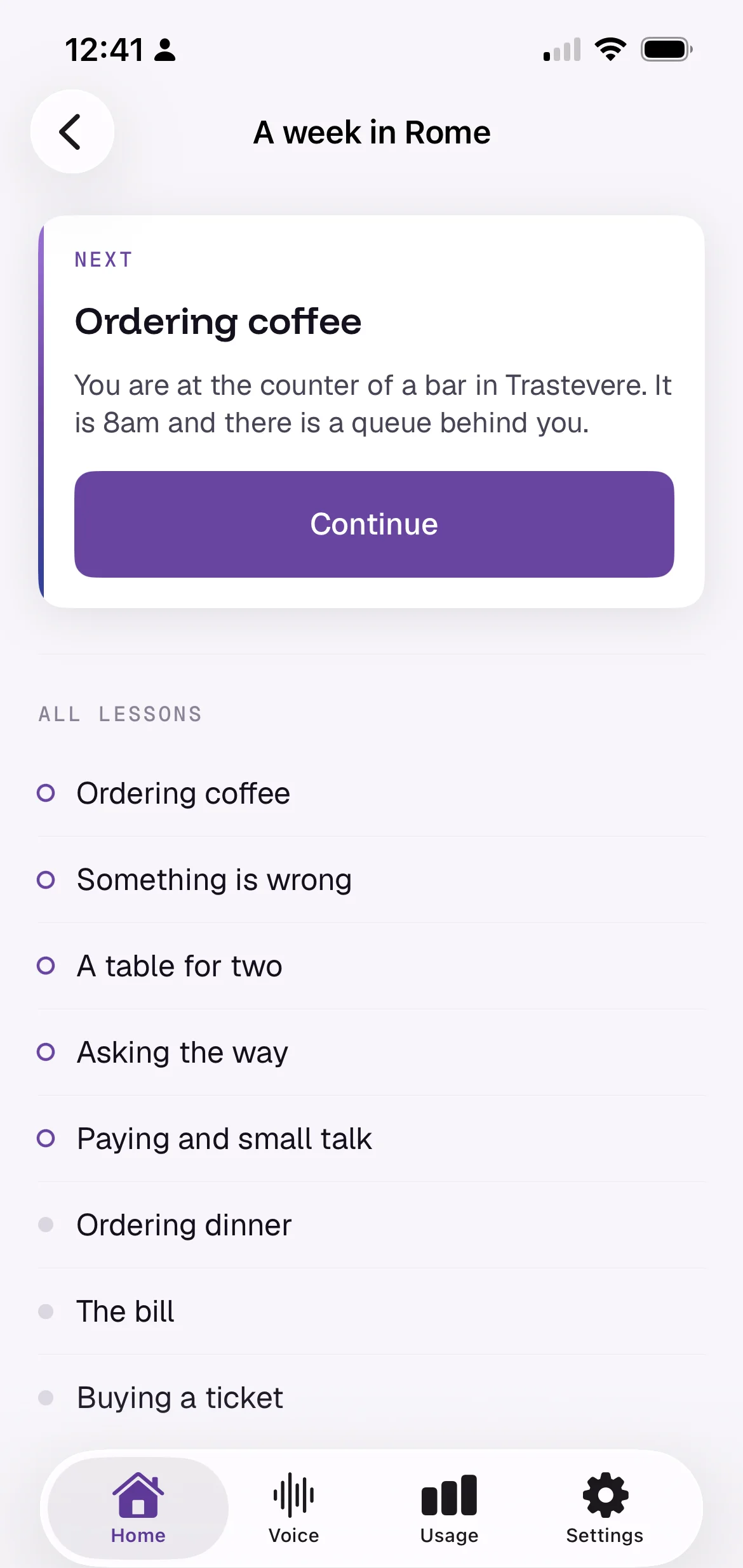
Every lesson is a short scene from real life, like ordering coffee in Rome or finding your train in Tokyo. Out loud, from start to finish.
Choose where you want to be able to talk. Each scene teaches a few phrases you'll really use.
The tutor sets the scene in your language, then says the phrase slowly in the one you're learning.
It listens to how you said it and fixes one thing at a time. The tricky word, slowly, then the whole phrase again.
Once you have the phrases, the tutor plays the waiter, the stallholder, the stranger on the platform. You answer as yourself.
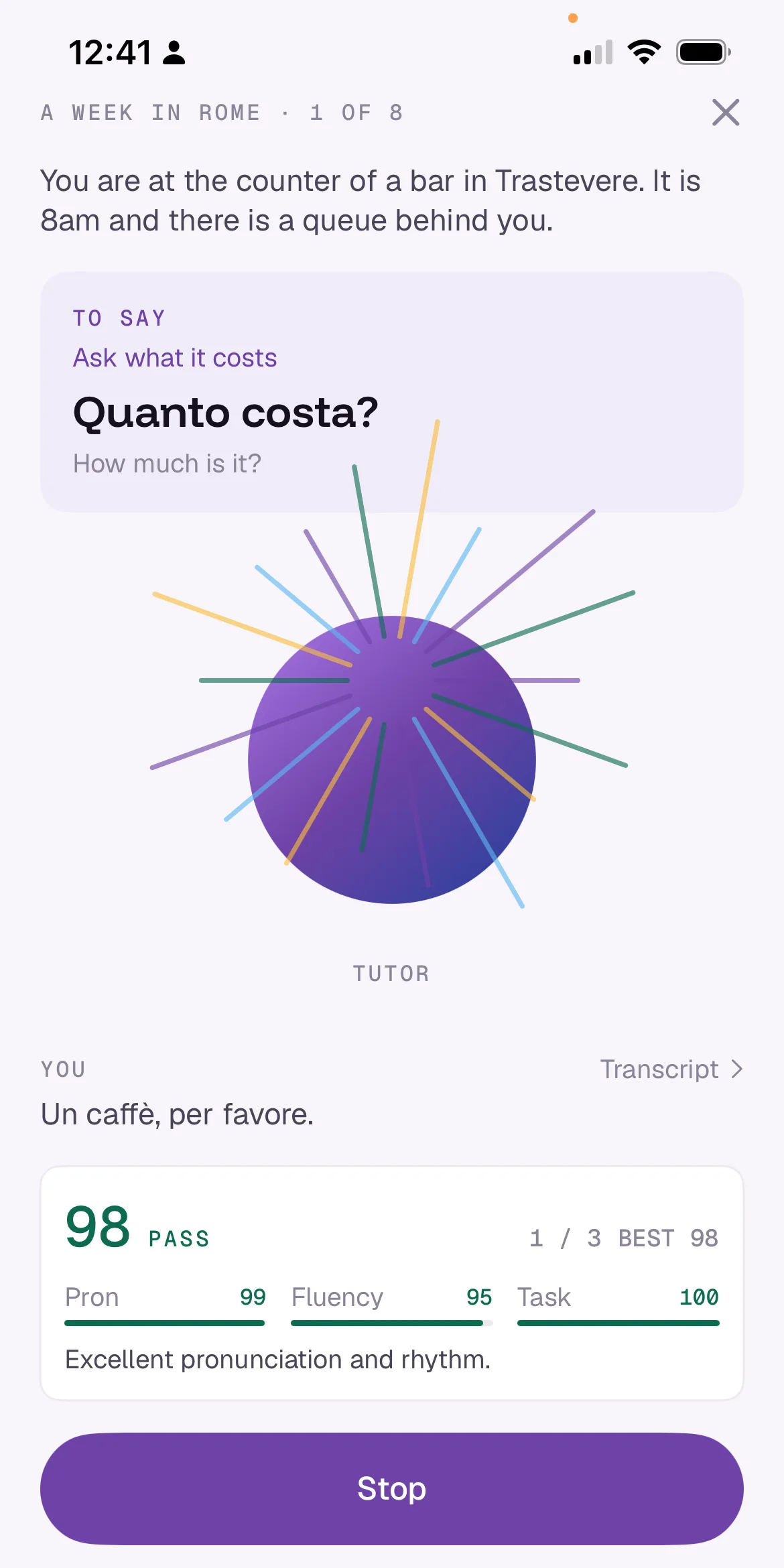
Good teachers don't hand you a list of mistakes. They tell you what you got right, then give you the one thing to try next.
"The rhythm was right." "You landed the double consonant." Not "good job." You learn what worked.
It names the one word that slipped and says it slowly, then lets you try again. Trying again is part of the conversation.
Your pronunciation score and the word to work on show up on screen. The tutor never reads numbers out, so a lesson never turns into a test.
Instructions and corrections come in the language you speak. The phrases come in the one you're learning. Never mixed in the same sentence.
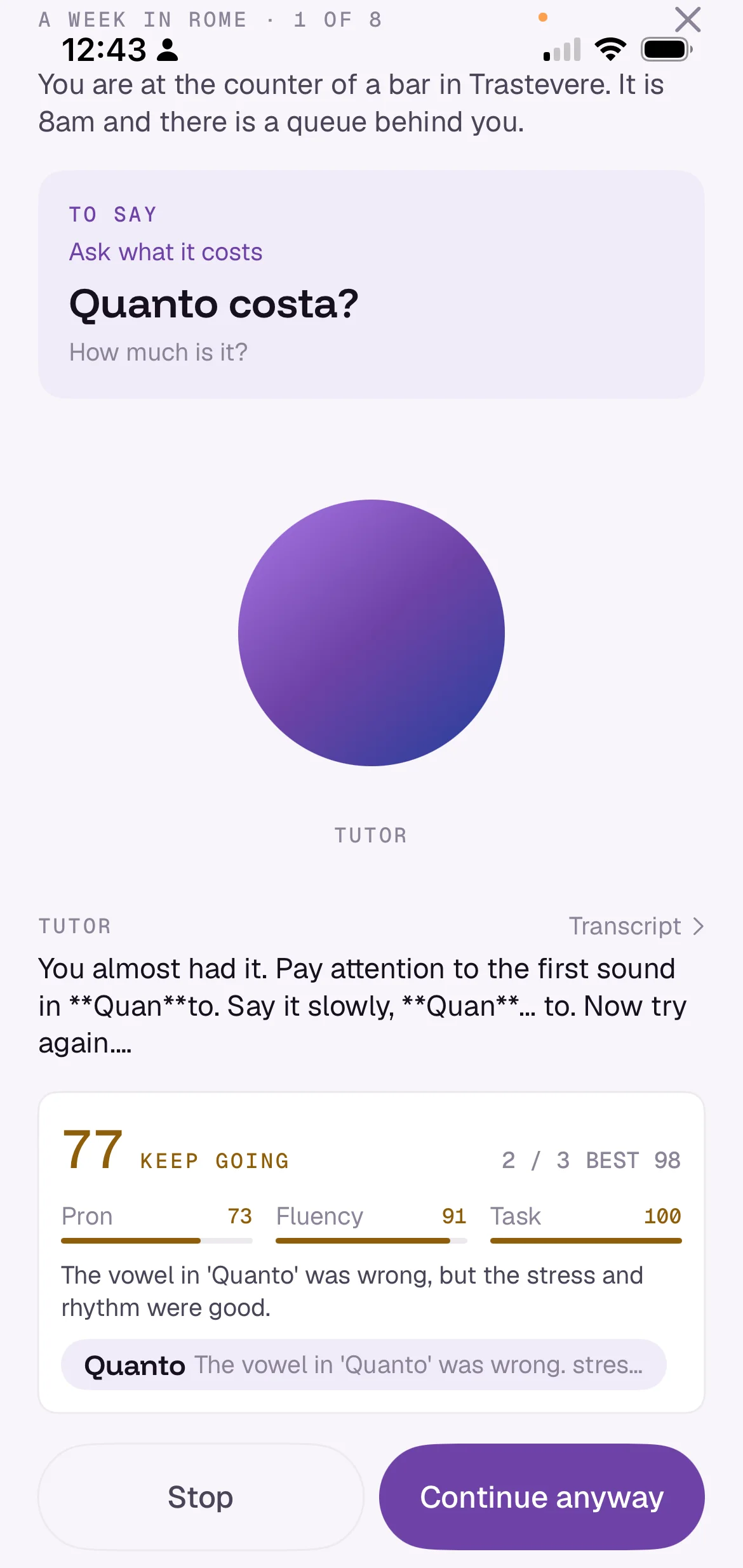
No mic button, and nothing to tap between sentences. A lesson has one control: Stop. Put your earbuds in and keep your eyes where they need to be.

Courses are built around places, not grammar chapters. You practise the phrases you need the day you land.
Order, ask, apologise, and get where you're going.
Italian
Buy food, haggle a little, and leave with what you wanted.
Spanish
Trains, konbini, and asking for help without English.
JapaneseHundreds of classes in every language, graded 1 to 10. Level 1 is your first words; level 10 is business you would be nervous doing in your own language. And the list works twice over: every language here is one you can learn, and every one is a language Yomita Tutor can teach in, so the explanations always arrive in words you already have.
Hundreds of classes across seventeen languages, all of them spoken out loud — and every one sits somewhere on a ladder from 1 to 10. Each level answers a single question: how much does the other person have to adapt for the conversation to work? At level 1 they carry the whole exchange. At level 10 they do not adapt at all, and do not notice that they aren't.
Yomita Tutor focuses on levels 1 to 6 — from your first words to holding your own in a disagreement. Levels 7 to 10 describe the rest of the climb.
You use language you were given.
A few memorised sounds: hello, thank you, your own name. Natural speed is noise, and the other person carries the whole exchange.
Nouns, numbers and a handful of sentence frames with one word swapped in. Predictable transactions work — until one of them goes off script.
You build sentences instead of retrieving them, and you can ask someone to repeat or slow down. That one skill turns a transaction into a conversation.
You build your own, and handle what you did not plan for.
What happened, what will happen, and why. Slow, rough and self-corrected, but genuinely yours rather than assembled from memorised units.
A problem, a complaint, an appointment that moved — situations you never rehearsed. You could live there with nobody translating for you.
You take a position and defend it, disagree, persuade, decline. You start hearing what is meant rather than only what is said.
Correct is assumed. Fitting the situation is the measure.
The same sentence formally or casually, and you know which one the moment wants. People stop using simplified speech with you.
You do your job in the language on familiar ground: meetings, correspondence, explaining your work, asking for help. Accurate, and still tiring.
You represent your side to outsiders — clients, negotiations, bad news, disagreeing with someone senior. Your remaining mistakes no longer cost you authority.
The language stops being the obstacle.
Nobody accommodates you: people talking over each other, regional accents, humour, hostility, the unstructured hour afterwards. You still have an accent and gaps, and they cost you nothing.
We judge Tutor by what you can say at the end of a lesson, not by how long you stayed in the app.
No streaks to protect and no guilt notifications. A short lesson is a good lesson.
Audio goes straight from your phone to the model. We never receive it, so there is nothing on our side to store.
No password, no profile to fill in. Pick a language and start talking.
That's the idea. You talk and it talks back. It hears the attempt you actually made, says what was right about it, and gives you one thing to change. There are no multiple-choice screens and no buttons between sentences.
No. There's no microphone button and nothing to press between sentences. The tutor speaks, you answer out loud, and it goes on from there. A lesson has one control: Stop.
A short scene from real life, practised out loud — some take a couple of minutes, some longer.
Yes. The tutor says every phrase first, slowly, and explains and corrects in the language you already speak.
No. Lessons are hands free with one control, Stop. Your score and the word to work on appear on screen if you want to look.
Seventeen: Arabic, Chinese, Dutch, English, French, German, Indonesian, Italian, Japanese, Korean, Polish, Portuguese, Russian, Spanish, Thai, Turkish and Vietnamese. The same seventeen are the languages it can teach in, so whichever one you already speak, the setup and the corrections arrive in it.
Not yet. The ready-made courses are Italian, Spanish and Japanese — A week in Rome, The Saturday market and Three days in Tokyo. The other fourteen are taught, just without a trip built around them yet.
Yomita Translator speaks for you, live, while you're still learning.