Catch the Moment, Not the Screen
Why a translator that interrupts the moment has already failed
Every real-time translator asks you to pay for the translation in the one currency you cannot spare: either everybody wears something, or somebody keeps tapping and turning a screen. Both work, and both kill the moment they were meant to save. Yomita is built to behave like an interpreter instead — nothing in anyone's ears, nothing in your hands.
There is a particular silence that falls when two people want to talk and cannot. It lasts about three seconds. Then somebody smiles, somebody shrugs, and the thing that might have happened does not happen.
Every real-time translator built so far asks you to buy your way out of that silence, and the price is always the same shape. Either everybody involved puts something in their ears, or somebody keeps tapping a screen and turning it around. Both of those work. Both also cost you the exact thing you were trying to have.
The translation was never the hard part. The moment is the hard part, and a moment does not survive being operated.
Three silences
A Sunday market in Rome. A man has a table of old brass door handles and one of them is beautiful. He picks it up and starts telling you where it came from — a building, a year, somebody's grandmother, a war, you cannot tell which. He is not selling. He is enjoying himself. You catch two words in thirty. So you smile, you nod at what sound like the pauses, you pay the first price he said because haggling requires sentences, and you carry the handle back to the hotel having left the entire reason it was worth buying on the table. That evening the owner comes over to tell you what is good tonight, which is not written anywhere, and you order the thing you can point at. Nine days in Italy, and the only Italians you spoke to were the ones paid to be patient with you.
A counter in Japan. Tokyo and Kyoto are easy for about four days. Then somebody on a train mentions a town two hours out, and you do not go — not because it is hard but because you cannot ask what time the last bus comes back, and you can picture yourself standing at an unlit stop with that question and no way to ask it. So you stay where the signs are bilingual. Even there, the good places are shut to you: six seats, a menu brushed on a wall, a ticket machine with twenty-two buttons and no English on any of them. You eat where there are photographs. In a shop a woman wants to explain the difference between two teas — she has taken both down, one in each hand, she is genuinely trying — and it ends with you buying neither and thanking her in the one word you have.
A street, anywhere. And then the one that never appears in a product brochure. You are in a queue, or a bar, or waiting out the same delayed train, and someone catches your eye and says something, and you both laugh at nothing. There are perhaps five seconds in which this becomes a conversation or does not. Five seconds is not enough time to unlock a phone, find an app, type, and turn the screen around. It is barely enough time to say something foolish in your own language. So you smile, she smiles, the train arrives.
Nobody's life is ruined by any of this, which is exactly why it is so easy to accept. You simply come home with a smaller trip than the one you went on.
What actually kills it
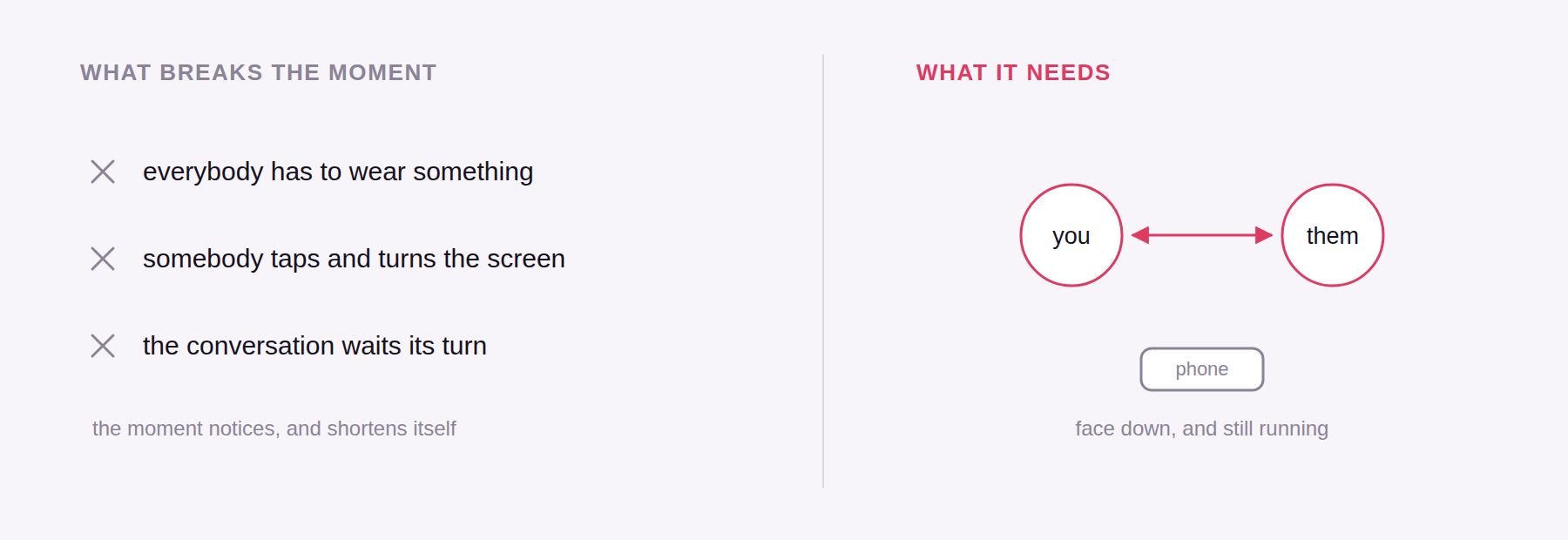
Three things, and not one of them is the translation.
Earbuds need everybody. Translation through a pair of headphones is excellent, and it requires the other person to be wearing the other pair. The man with the door handles is not. The woman with the two teas is not. Nobody at a bus stop, a market stall or a bar has ever been about to put one in.
Tapping needs your attention, and theirs. A phone held up between two faces is a small announcement: we are now performing a procedure. People shorten their sentences in front of it. They stop telling you about the grandmother and start giving you information. The story was the thing you came for, and it is the first thing the procedure kills.
Turn-taking needs a queue. Real talk overlaps. Someone finishes your sentence, three people laugh at once, the waiter arrives mid-thought. A system that waits politely for one speaker to stop before the next may begin has imposed a meeting on a dinner.
An interpreter, not a translator
Think about what a human interpreter at a table actually does. They sit slightly back. Nobody hands them anything or waits for them to be ready. Nobody wears anything. Above all, nobody looks at them — the two people look at each other, which is the entire reason the interpreter is there.
That is the thing we are building, and it is a different thing from a better box to speak into.
The phone goes face down on the table and stays there. Each of you hears the other in your own language, out loud, and Yomita works out when you have stopped speaking rather than waiting to be told. The other person installs nothing, joins nothing, scans nothing and need not know it is running. You can hold a menu, a glass, a door handle, somebody's hand.
It chooses the register, too, which is the part people do not expect to matter and then cannot live without. French has tu and vous. Japanese has an entire grammar of politeness. A system that renders a flirtatious line in the form you would use with a tax inspector has translated every word correctly and destroyed the sentence. You tell Yomita what kind of conversation this is, and it speaks like a person in it.
And it interprets rather than assists. No greeting, no "sure, I can help with that", no remarks about what you just said. Only what you said, in their language, in your manner. That sounds obvious until you hear a translator built on a chat assistant introduce itself to your date.
Where the other shapes genuinely fit
Earbud translation is very good when both sides have a pair — a colleague you work with every week, a guided tour, a planned meeting where somebody hands them out. Meeting platforms are the right answer for a conference with two hundred people and simultaneous interpretation; a phone on a table is not. And if you need a sign read or a menu understood, Google Translate is free, offline and better at it than we are.
We are built for the case in between, which is most of life: two or three or six people, physically together, in something that will not pause while you operate software.
Talk with anyone, anywhere
That is the line, and it is not really about translation.
It means asking the driver why that building has scaffolding, and getting the story about the mayor. It means taking the recommendation that was never on the menu. It means going to the town two hours out, because asking about the last bus is now a thing you can do. It means buying the door handle and learning whose it was. It means the five seconds on the platform being enough, because you can answer inside them.
Seven thousand languages, and the ones you happen to have been born into should not decide who you get to know. That is the whole ambition. Not a smaller language barrier — no barrier, and nothing in your ears, and nothing in your hands.
If it works, you will not think about the software at all. You will remember the man with the door handles, and what he told you about his grandmother.
Questions
- Why not just use earbud translation?
- It is very good when both sides have a pair — a colleague, a planned meeting, a guided tour. It cannot help with the stall holder, the shop owner or the stranger at the bus stop, and those are most of a trip.
- Do the people I am talking to need the app?
- No. Nobody else installs anything, joins anything, wears anything, or needs to know it is running.
- How is this different from Google Translate?
- Google Translate is free, offline and better than we are at reading a sign or a menu. Yomita is built for a conversation that will not pause while you operate software: the phone stays face down, both of you hear the other aloud, and the register is chosen for the situation.