I Just Want to Order the Coffee
Why learning a language for a trip should not start with a syllabus
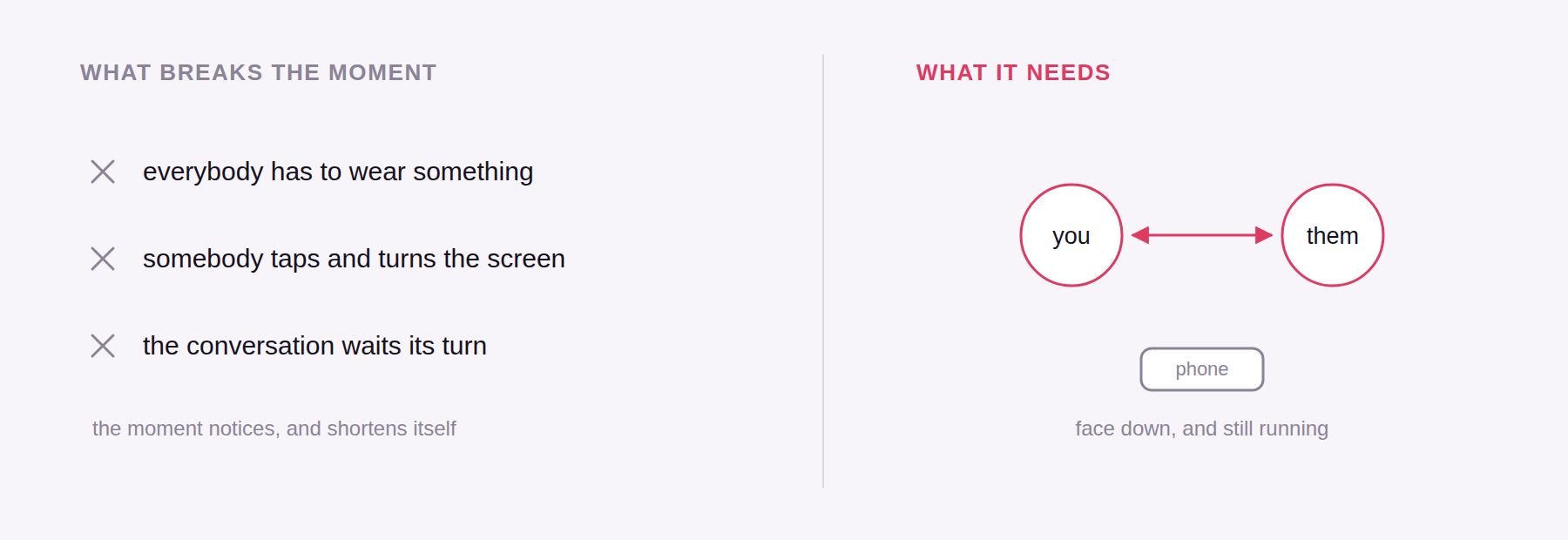
Travellers do not want a language, they want a moment to go well. A course is a commitment measured in terms and arrives in the wrong order; a video cannot hear you, so a wrong vowel gets rehearsed forty times. Yomita Tutor teaches one scene at a time, out loud, and corrects the pronunciation as you go.
You are going to Italy in three weeks. What you would like, on arrival, is to order a coffee properly — not point at it, not say it in English more loudly, but say the sentence the way a person who lives there says it and be understood the first time.
There are two normal ways to get that, and neither of them is the shape of the thing you asked for.
A course is the wrong size
Enrol in a class, in a room or online, and you have signed up for something much larger than a coffee. Terms, units, homework, an hour on Tuesday evenings. It wants your attention on a schedule, and most of that attention goes to the room or the screen rather than to Italy.
It also arrives in the wrong order. A course teaches a language systematically, which means the one sentence you need is somewhere in unit nine, behind the present tense of every verb in the book. By the time you reach it the trip is over and what you retained is that Italian has a great many verbs. None of this is a criticism of courses. If you want the language, take one. But a course is a commitment to a language, and what you made was a commitment to a holiday.
A video cannot hear you
So most people do the sensible thing and watch instead. Ten phrases for travellers. Order food in Japanese in five minutes. Some of these are made by very good teachers and they are free, which is difficult to argue with.
They also cannot hear you, and that turns out to be the whole problem.
Speaking is a physical skill, and physical skills need a correction loop. You repeat the phrase into your kitchen, it sounds close enough to you, and nothing in the world tells you otherwise. Recognising a sound is not the same as producing one — your ear forgives your mouth, because your mouth is doing what your own language trained it to do. So you can practise a wrong vowel forty times and become fluent at being wrong. Then you say it at a counter and the answer is a polite "sorry?", which is the moment you finally find out, and the worst available moment to find out.
What people are actually asking for
Listen to how travellers describe the goal and it is never "Italian". It is:
I want to order a coffee without switching to English.
I want to open a conversation and not have it die in four seconds.
I want to say thank you like someone who means it rather than like a phrasebook.
I want to say one thing well enough that the other person's face changes.
That last one is the real motive and it is on nobody's course brochure. You are not trying to acquire a language. You are trying to make an impression on a particular person in a particular moment, with about eight words to do it.
So we built a tutor for exactly that
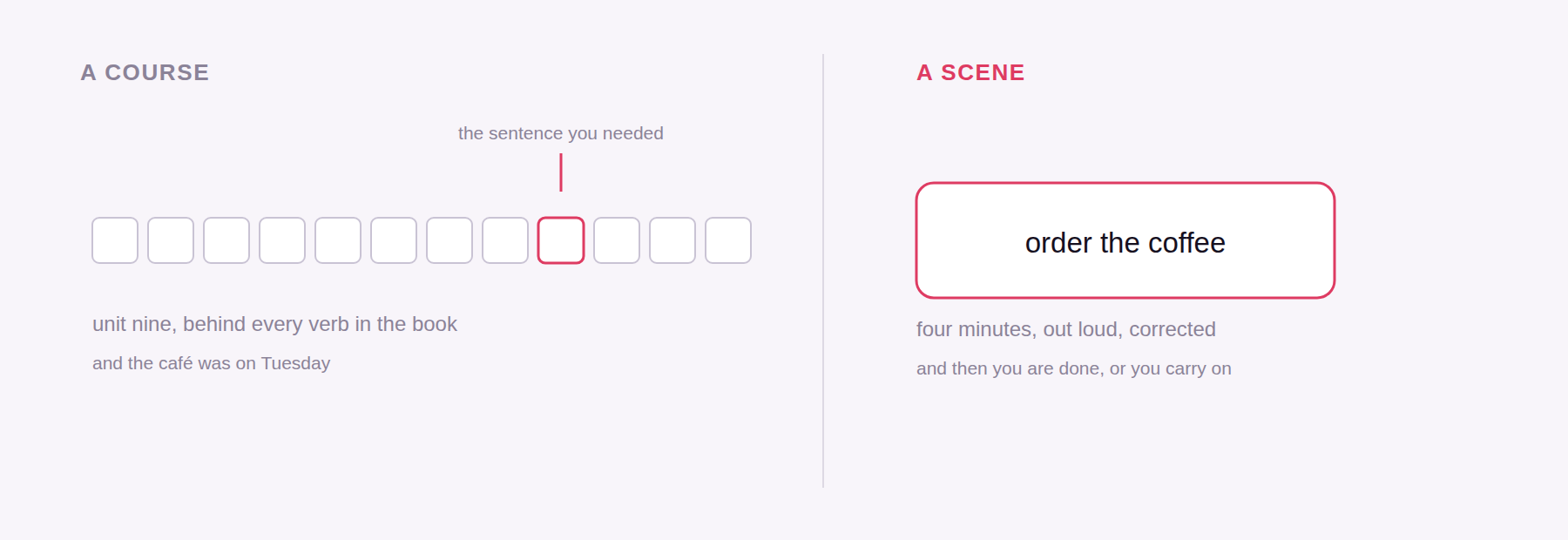
Yomita Tutor teaches a scene rather than a syllabus. You choose the situation — the counter, the taxi, the first thirty seconds with somebody you would like to keep talking to — and the lesson is that situation, two to four minutes long, spoken out loud.
You speak. It listens. When the vowel is wrong it tells you and has you say it again, which is the thing the video could not do and a class of twelve manages perhaps twice an hour. You can interrupt it mid-sentence, ask it to slow down, ask why it is that word and not the other one, or ask it to teach the whole thing a different way — everything you would do with a patient human teacher and would never do with a playlist.
Seventeen languages, and ten levels if it turns out you want the language after all. But taking one scene, getting it right, and stopping there is a complete and perfectly respectable use of it.
Learning a language is a project measured in years. Being understood at a counter on Thursday is not, and it should not have to wait for the other one.
Yomita Tutor is coming to iOS.
Questions
- Can I learn just one situation and stop?
- Yes, and that is a complete use of it. A scene takes two to four minutes. Seventeen languages and ten levels are there if you decide you want the language after all, but nothing obliges you to go on.
- How is this different from a language app with streaks and flashcards?
- Those test recognition — whether you can pick the right answer. Tutor asks you to say the thing aloud and tells you when the sound is wrong, which is the part you cannot check for yourself.
- Can I interrupt it or ask it to slow down?
- Yes. You can cut in mid-sentence, ask it to slow down, ask why it chose that word, or ask it to teach the same thing another way — the things you would do with a patient human teacher.